 TopWeb3
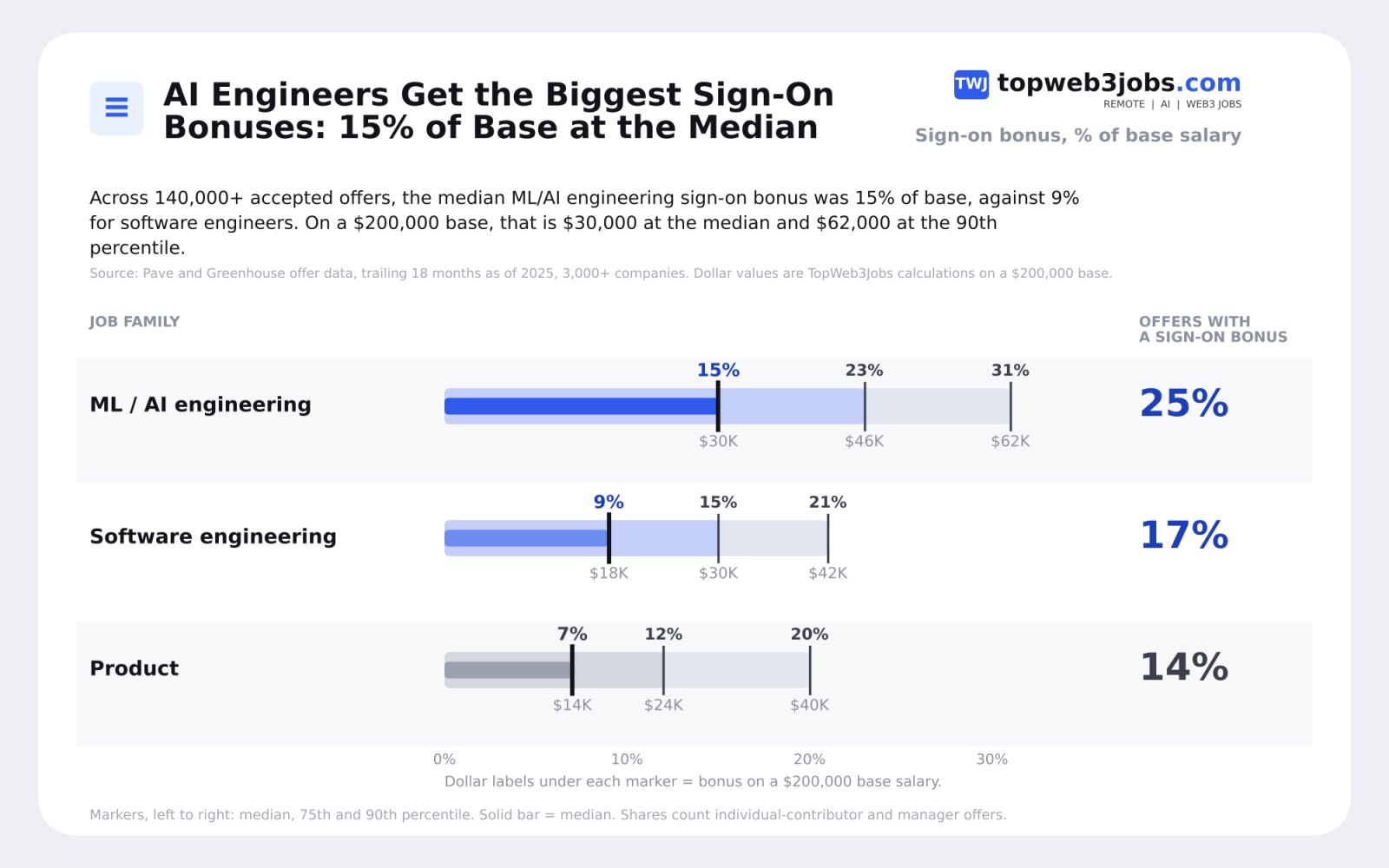
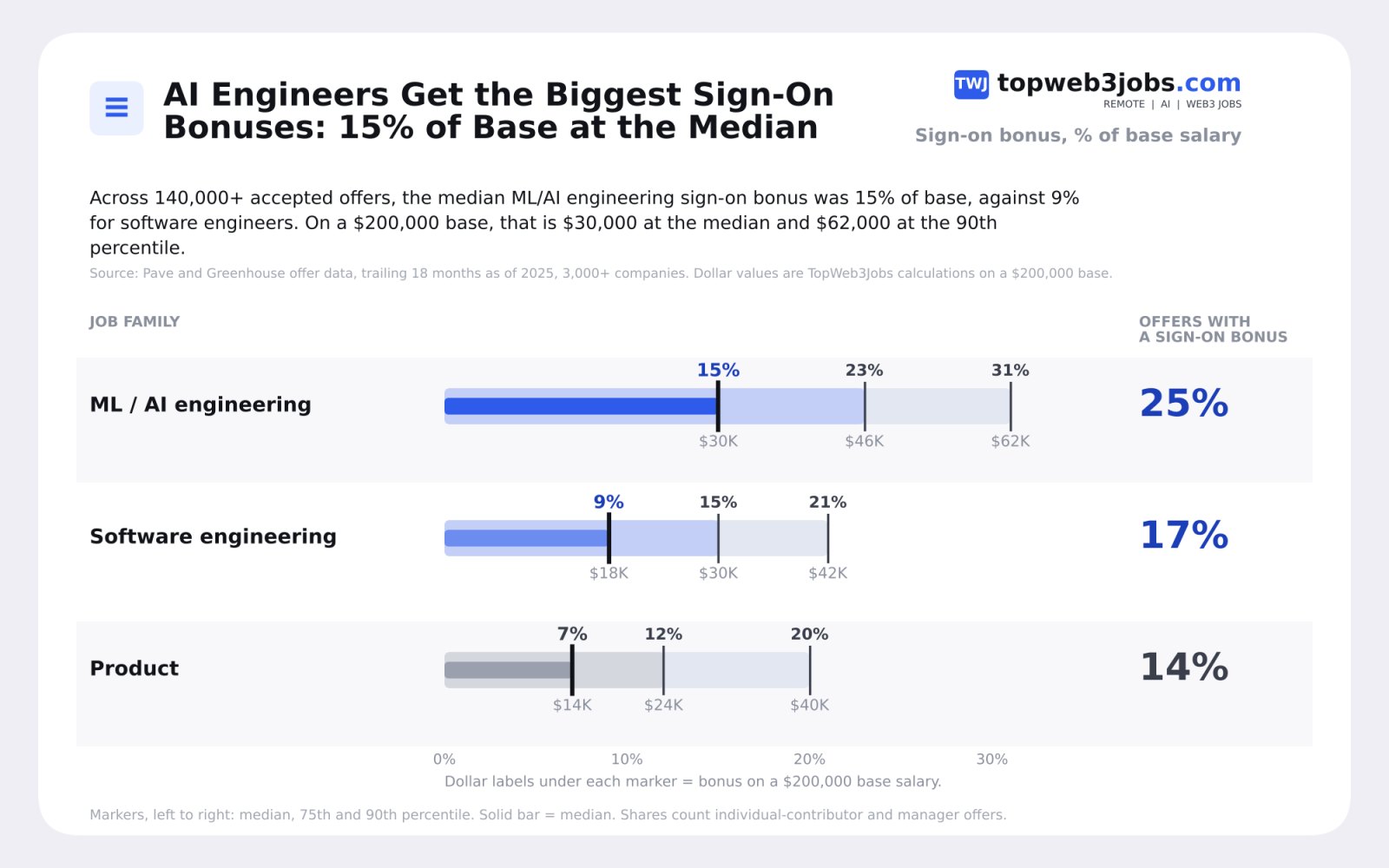
- The median sign-on bonus for ML/AI engineers is 15% of base salary, with the 75th percentile at 23% and the 90th at 31%
- For software engineers, the median is 9% of base, the 75th percentile 15% and the 90th 21%
- 25% of ML/AI engineering offers include a sign-on bonus, against 17% for software engineering
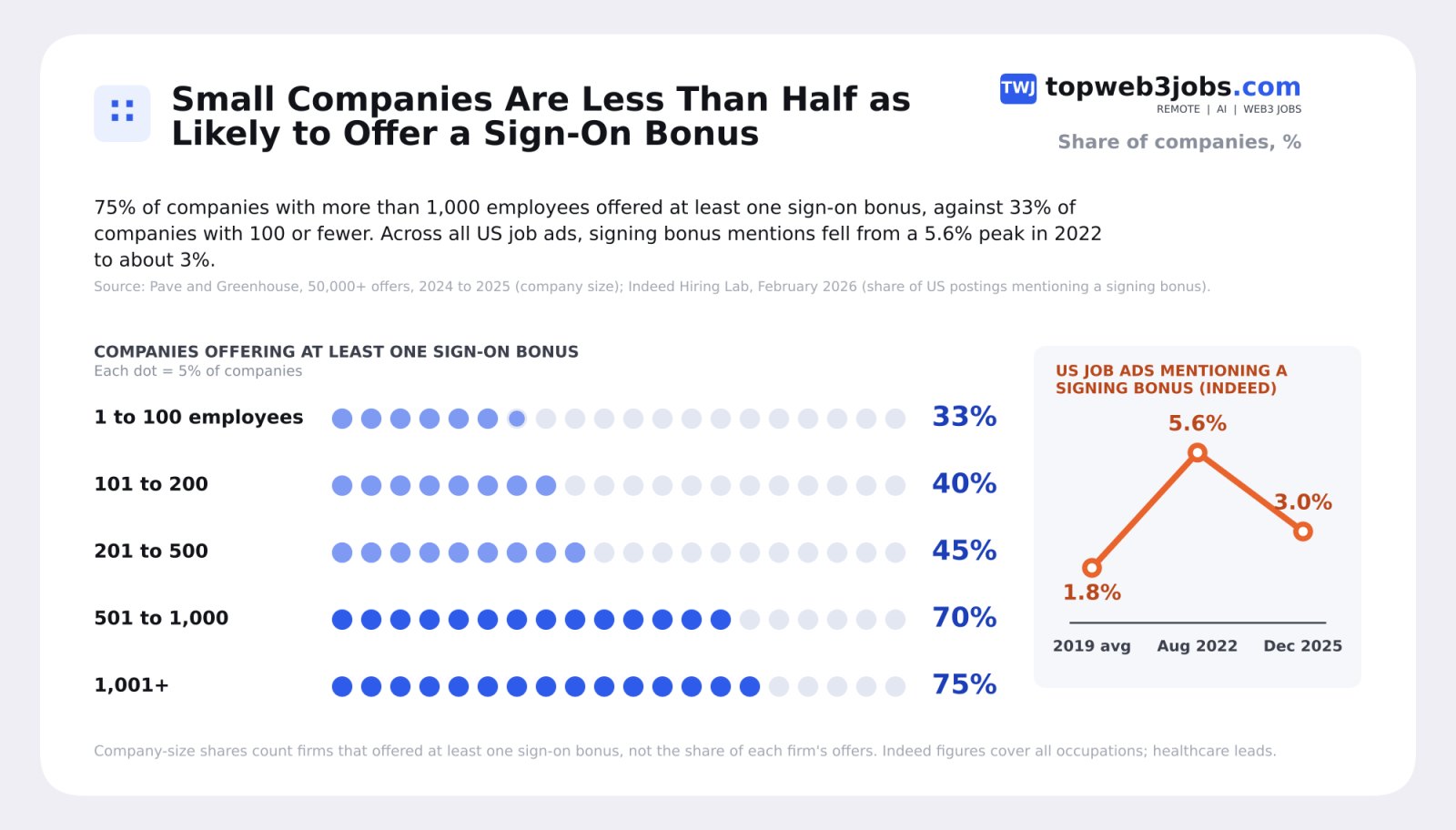
- 75% of companies with more than 1,000 employees offered at least one sign-on bonus, against 33% of companies with 100 or fewer
- Signing bonus mentions in US job ads fell from a 5.6% peak in August 2022 to about 3% in December 2025, still above the 1.8% average of 2019
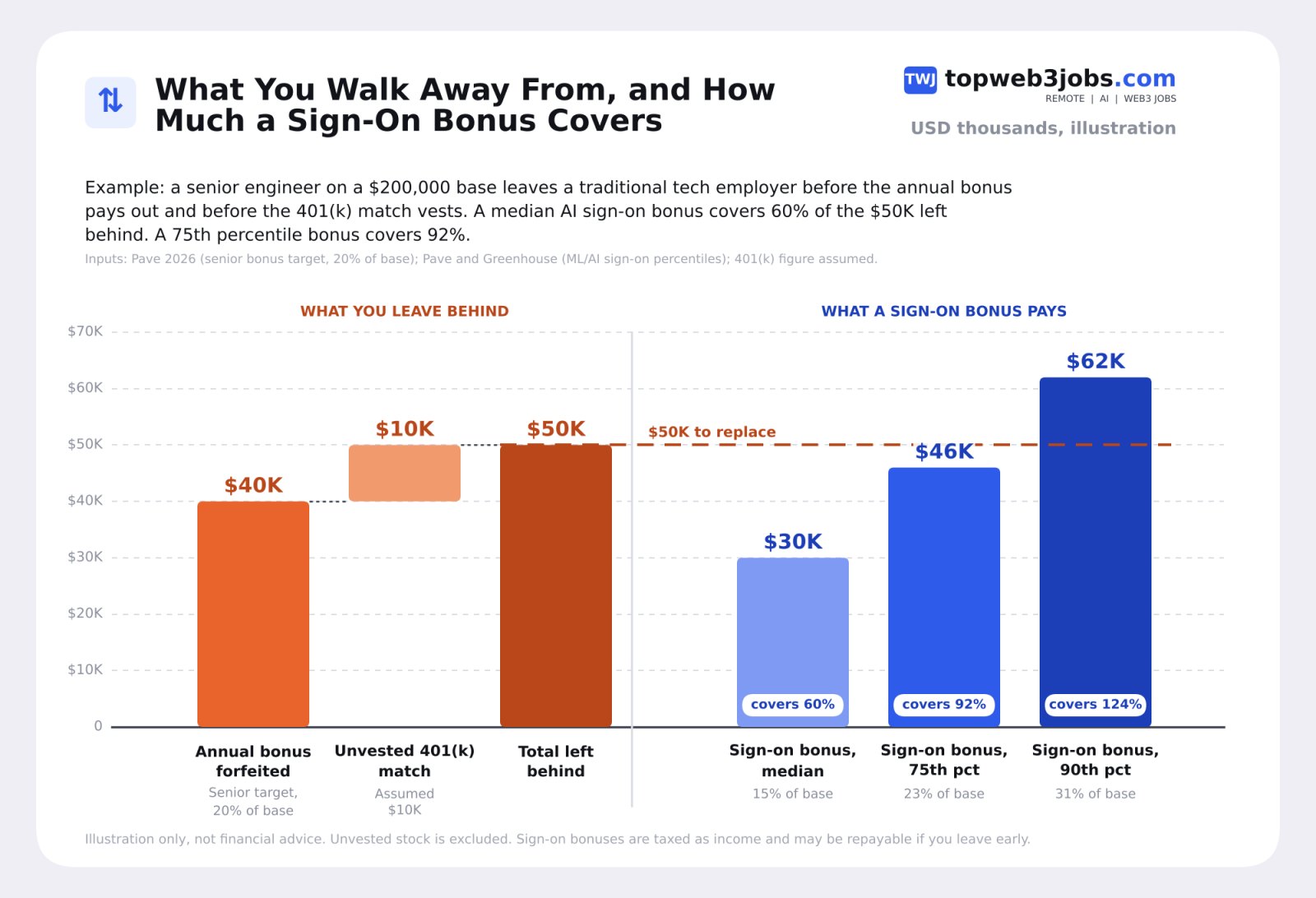
- The median annual bonus target for senior engineers is 20% of base, which is often forfeited when someone leaves mid-year
How Big Sign-On Bonuses Really Are
The best recent data comes from Pave, which analyzed more than 140,000 accepted offers across more than 3,000 companies with Greenhouse.
ML and AI engineers receive the largest sign-on bonuses. The median is 15% of base salary. The 75th percentile is 23% and the 90th is 31%.
Software engineers receive less. Their median is 9% of base, the 75th percentile 15% and the 90th 21%. Product roles sit lower still, at a 7% median.
On a $200,000 base, those percentages translate into clear dollar ranges. A median software engineering bonus is about $18,000. A median ML/AI bonus is about $30,000. A 75th percentile ML/AI bonus is about $46,000.
That is where the $10,000 to $50,000 range comes from. Most negotiated sign-on bonuses for experienced engineers land somewhere inside it.
Sign-on bonuses are also more common for AI roles. 25% of ML/AI engineering offers include one, against 17% of software engineering offers.
Who Pays Them, and Who Does Not
Company size is the strongest predictor of whether a sign-on bonus is on the table.
Pave's data on more than 50,000 offers shows that 75% of companies with over 1,000 employees offered at least one sign-on bonus. Only 33% of companies with 100 employees or fewer did.
This matters for anyone moving into Web3. Most crypto companies are small. Carta reports that the median seed-stage startup has four employees and the average Series B company about 45. A remote Web3 team is far more likely to sit in the "less likely to pay" band.
The wider market has also cooled. Indeed Hiring Lab found that about 3% of US job ads mentioned a signing bonus in December 2025. That was down from a peak of 5.6% in August 2022, though still above the 2019 average of 1.8%. Healthcare roles now dominate the occupations that still advertise them.
Larger hubs still show room to negotiate. If your current desk is in a Manhattan office, what crypto and AI teams across New York are paying right now is a useful check, with posted ranges from $150,000 to $250,000 for product and market expansion roles.
What You Are Actually Asking to Replace
A sign-on bonus works best when it is framed as replacing something specific. Engineers leaving traditional tech usually give up three things.
The annual bonus. Pave's 2026 data puts the median bonus target at about 10% of base for junior engineers and 20% for senior engineers. 73.7% of professionals at public companies have a formal bonus plan. Leave before the payout date and that money is usually gone.
Unvested retirement contributions. Vanguard data shows that 51% of 401(k) plans use a vesting schedule on employer contributions. Forfeitures happen in 30% of job separations, and when they do, they average 40% of the departing worker's balance.
Unvested stock. Equity that has not vested is lost when you leave. Even vested startup options are often left behind. Carta found that more than 75% of vested equity held by departing startup employees in 2024 expired without being exercised.
In our example, a senior engineer on a $200,000 base leaves before a $40,000 annual bonus pays out and before $10,000 of 401(k) match vests. That is $50,000 left behind before counting any stock. A median ML/AI sign-on bonus of $30,000 covers 60% of it. A 75th percentile bonus of $46,000 covers 92%.
How to Negotiate It
The steps below are a TopWeb3Jobs editorial guide built on the data above. They are not legal or financial advice.
List what you lose, in dollars. Write down your bonus target, the date it pays out, your unvested 401(k) match and your next stock vest. A concrete number is easier for a recruiter to take to a hiring manager than a general request.
Ask after the offer, not before. Raise the sign-on bonus once you have a written offer and the base salary is settled. Sign-on cash is a one-time cost for the company, so it is often easier to approve than a higher base.
Use the right benchmark. For AI and ML roles, 15% of base is the median and 23% is a strong but realistic ask. For general software roles, 9% to 15% is the usual range.
Read the repayment terms. Many sign-on agreements require repayment if you leave within a set period. Ask how long that period is and whether repayment is prorated. Remember that in the US, a sign-on bonus is taxed as ordinary income.
Have a fallback if there is no cash. Small Web3 teams may not have a sign-on budget. Many crypto companies do not publish salary ranges at all. Helius, for example, has four remote openings listed with no range on any of them, which means the whole package is open to negotiation. In those cases, ask for a larger token or equity grant, an earlier vesting cliff, or a start date after your current bonus pays out.
The Web3 Angle: Cash Is Scarcer, Tokens Are Not
Web3 compensation is built differently from traditional tech pay.
Pantera's 2024 survey found that 82% of crypto professionals work fully remote, so remote work itself is not something a Web3 employer will treat as a perk you should pay for.
Equity and token grants vary widely by sector. Pantera found median grants of $10,000 in DeFi, $80,000 in infrastructure and $250,000 in NFT companies. In sectors with larger grants, asking for extra tokens in place of a cash sign-on bonus can be the more realistic path.
Engineers coming from banks or fintech may find the most familiar ground on the finance side of crypto. Treasury, trading and lending teams are hiring across several cities, and their roles are often the closest match to a traditional finance or fintech background.
Read the Numbers With Care
Sign-on percentages come from accepted offers in a commercial dataset. They reflect companies that use Pave and Greenhouse, which skew toward funded US technology firms.
The company-size figures count firms that offered at least one sign-on bonus, not the share of each firm's offers that included one.
Our $50,000 example uses one set of assumptions. Your own number may be much higher if a large stock vest is close, or much lower if your employer pays no bonus.
What to Watch Next
First, AI hiring pressure. As long as AI roles keep growing faster than the wider market, sign-on bonuses for ML and AI engineers should stay above those for general software roles.
Second, Web3 funding. Larger crypto companies with more cash are more likely to offer sign-on bonuses. A strong funding cycle could narrow the gap with traditional tech.
Third, the end-of-year timing. Many annual bonuses pay out in the first quarter. Engineers who can time a move after their payout reduce what they need a sign-on bonus to replace.
The data supports one practical rule today: price what you are leaving in dollars, then ask for a sign-on bonus that covers it, and if the company cannot pay cash, ask for the same value in equity, tokens or timing.
Sources:
- Pave, "When hiring for your business, should you offer a sign-on bonus to close candidates?": 140,000+ accepted offers and 50,000+ offers with Greenhouse, sign-on percentiles by job family, share of offers and companies offering sign-on bonuses; Pave, average bonus percentage in tech (April 2026) and Pulse Survey 2025: bonus targets and plan eligibility
- Indeed Hiring Lab, "Healthcare hiring keeps signing bonuses alive in a cooling labor market" (February 26, 2026): 3% of postings in December 2025, 5.6% peak in August 2022, 1.8% in 2019; Vanguard data via the Plan Sponsor Council of America (February 18, 2025): 401(k) vesting schedules and forfeitures
- Carta, 2024 employee equity exercise data and State of Startup Compensation H2 2025: unexercised equity and team sizes by stage; Pantera Capital, Blockchain Compensation Survey 2024: remote share and equity grants by sector; TopWeb3Jobs city, company and category listings (October 2026)