 TopWeb3

Key Data
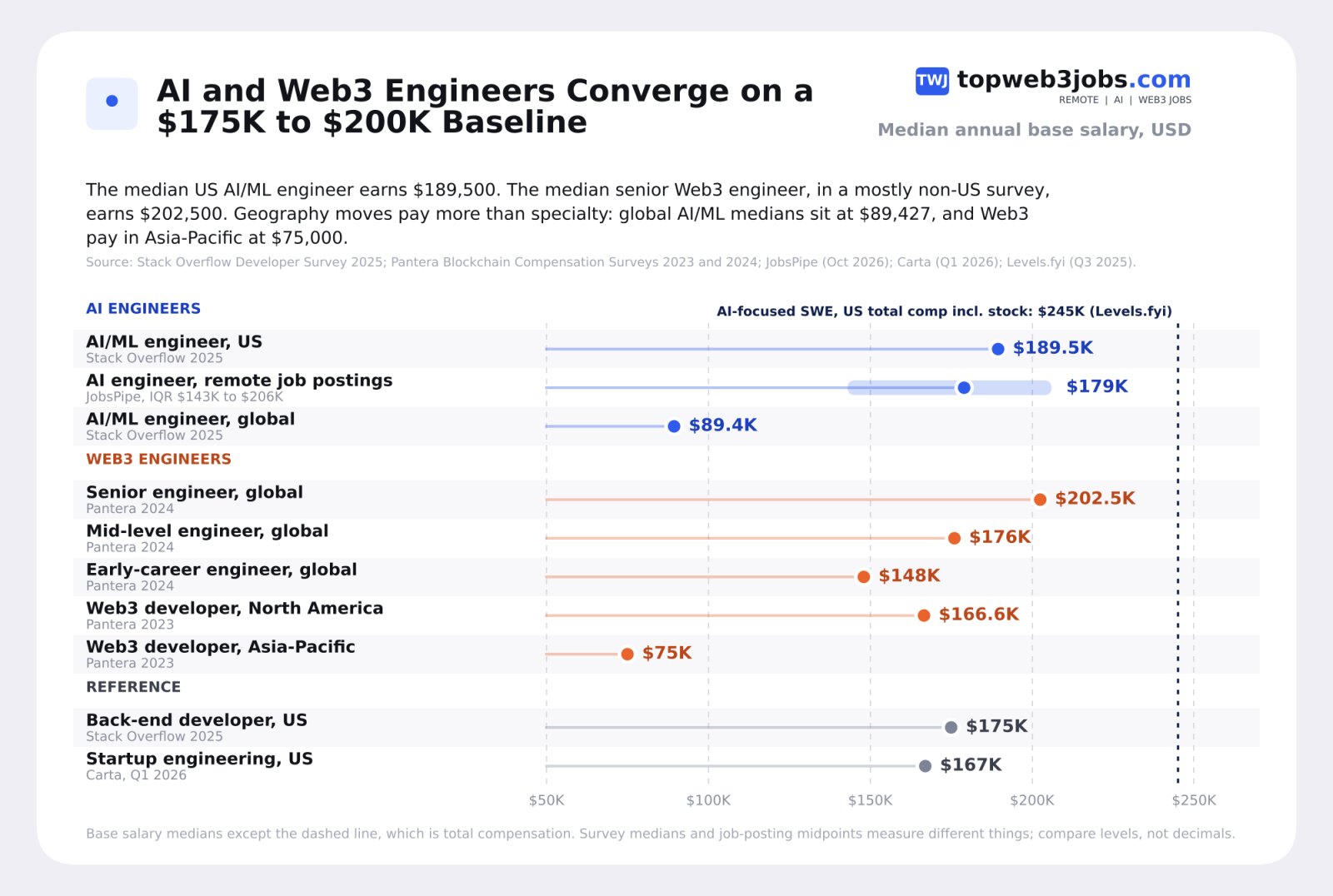
- The median US AI/ML engineer earns $189,500 in base salary, according to the Stack Overflow Developer Survey 2025. The global median for the same role is $89,427
- Pantera's 2024 survey puts the global median Web3 engineer salary at $148,021 for early career, $176,000 for mid-level and $202,500 for senior roles
- Live remote AI engineer postings show a median of $179,000, with the middle half between $143,000 and $206,000, based on 65 postings that disclosed pay
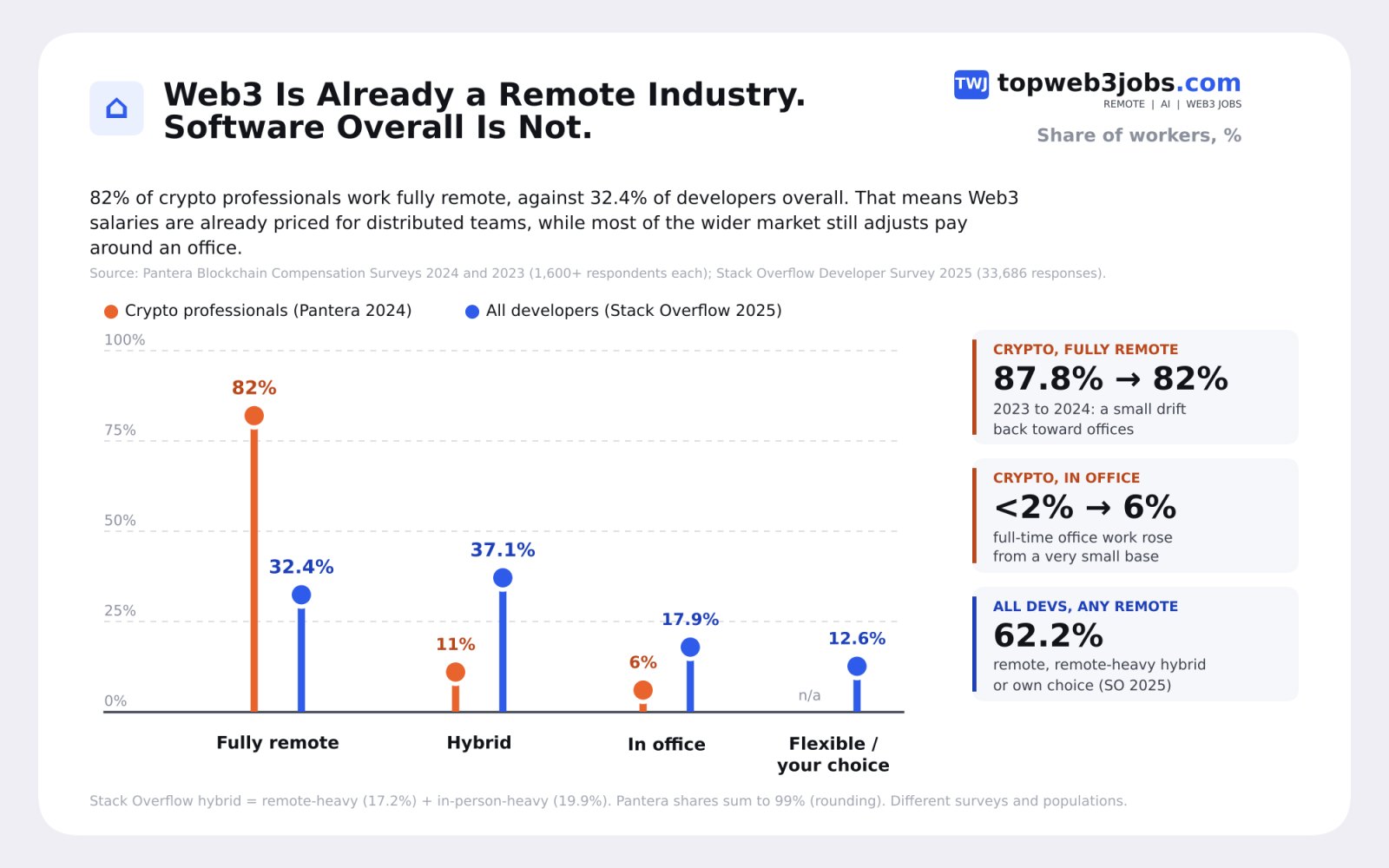
- 82% of crypto professionals work fully remote, against 32.4% of developers overall
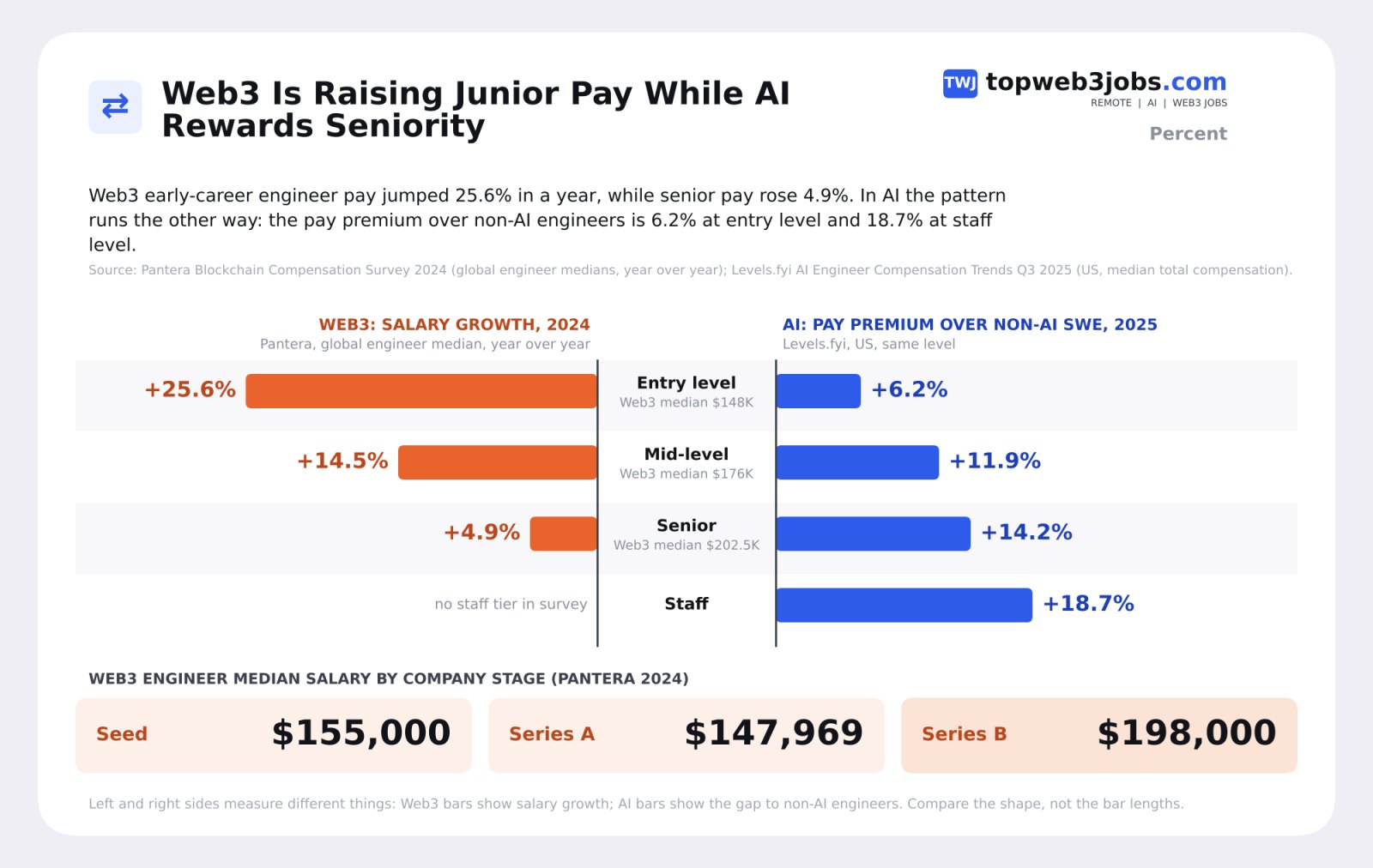
- Web3 early-career pay rose 25.6% in a year while senior pay rose 4.9%. In AI, the pay premium over non-AI engineers is 6.2% at entry level and 18.7% at staff level
- Web3 engineers at Series B companies earn a median $198,000, against $155,000 at seed and $147,969 at Series A
The Baseline: AI and Web3 Land in the Same Band
Start with the cleanest US number. The Stack Overflow Developer Survey 2025, built on 23,928 salary responses, puts the median US AI/ML engineer at $189,500. That is above the US back-end developer median of $175,000 and the full-stack median of $138,000.
Web3 has no separate category in that survey, so the best counterpart is Pantera Capital's Blockchain Compensation Survey. Its 2024 edition, published in August 2025 with more than 1,600 responses, puts the global median engineer salary at $176,000 for mid-level roles and $202,500 for senior roles.
Live job postings land in the same band. JobsPipe's October 2026 snapshot of remote AI engineer postings shows a median of $179,000. The middle half of disclosed ranges sits between $143,000 and $206,000.
Startups pay slightly less in cash. Carta reports a median engineering salary of $167,000 at US venture-backed startups in Q1 2026.
The shared baseline is roughly $175,000 to $200,000 for an experienced engineer in a high-pay market. Specialty moves you within that band. It rarely moves you out of it.
Total compensation is a different story. Levels.fyi puts the median AI-focused software engineer in the US at $245,000 once stock and bonus are included. That gap of about $55,000 over base salary is mostly equity, which is why a base-to-base comparison is the safer starting point.
Geography Moves Pay More Than Specialty
The biggest gap in the data is not AI versus Web3. It is the US versus everywhere else.
The global median AI/ML engineer in the Stack Overflow survey earns $89,427. That is less than half the US median for the same role.
Web3 shows the same split. Pantera's 2023 survey put the North American median developer salary at $166,610, against $102,226 in Europe, the Middle East and Africa, $90,559 in Latin America and $75,000 in Asia-Pacific.
For remote engineers this is the key question. A remote role priced from a US pay band and a remote role priced from a local band can differ by more than 2x for the same work.
Web3 Is Remote by Default
Crypto never built an office culture in the first place. In Pantera's 2024 survey, 82% of crypto professionals worked fully remote, 11% hybrid and 6% in an office.
The wider software industry looks very different. Stack Overflow's 2025 survey found 32.4% of developers fully remote, 37.1% hybrid and 17.9% fully in person, with 12.6% free to choose.
The trend in crypto is a small drift back. Fully remote work fell from 87.8% in 2023 to 82% in 2024. Full-time office work rose from under 2% to 6%.
For job seekers, this matters for pricing. Most Web3 pay bands were set for distributed teams from the start. Developers comparing engineering roles across AI and Web3 companies will often find the Web3 listings open to more countries, while AI labs more often tie roles to a hub city or a hybrid schedule.
Where the Curves Split: Junior Pay vs Senior Pay
The two sectors reward different stages of a career.
In Web3, junior pay is catching up fast. Pantera found early-career engineer pay rose 25.6% in 2024. Mid-level pay rose 14.49%. Senior pay rose 4.9%.
In AI, the reward sits at the top. Levels.fyi measures how much more AI-focused engineers earn than non-AI engineers at the same level. In 2025 that premium was 6.2% at entry level, 11.9% at mid level, 14.2% at senior level and 18.7% at staff level.
The two measures are not the same thing. One is pay growth, the other is a pay gap. But the shape is clear. Web3 is paying more to bring new engineers in. AI is paying more to keep its most senior ones.
Company stage also matters in Web3. Pantera's 2024 medians were $155,000 at seed, $147,969 at Series A and $198,000 at Series B. The jump at Series B is the largest step in the data.
Seniority is easier to prove when the work is public. As our research on GitHub profiles for Web3 recruiters showed, developers with two or more years in crypto now write 70% of the code. Those are the engineers the senior bands are built for.
Tokens and Equity Sit on Top of the Baseline
The base salary is the floor. What sits above it differs by sector.
In Web3, token and equity grants vary widely. Pantera's 2024 survey found median equity grants of $10,000 in DeFi, $80,000 in infrastructure and $250,000 in NFT companies. Most grants vest over four years, which was the schedule for 87.85% of respondents.
Infrastructure teams are worth a closer look. Teams hiring for protocol and infrastructure roles, such as node, ZK, Rust and DevOps work, sit in the sector where median grants are eight times larger than in DeFi.
Payment in crypto is still the exception. By the end of 2024, 9.6% of crypto workers were paid in crypto, up from about 3% in 2023. Of those payments, 90% were stablecoins, led by USDC at 63%.
In AI, the extra layer is usually stock. Levels.fyi's $245,000 total compensation median, against a base near $190,000, shows how much of an AI package depends on equity.
How to Find Your Own Baseline
The method below is a TopWeb3Jobs editorial guide built from the data above. It is not a pay formula.
Pick the market, then the role. Decide whether the employer pays from a US band or a local band. That choice moves the number more than whether the role says AI or Web3.
Match the level. Compare entry roles with entry medians and senior roles with senior medians. A senior Web3 median of $202,500 says nothing about a junior offer.
Compare base to base. Use the $175,000 to $200,000 band as a check for experienced engineers on US pay bands. Add equity or tokens only after the base is settled.
Check the stage. In Web3, a Series B company paid a median $198,000 in 2024, about $50,000 more than Series A. Ask where the company sits before you anchor on a number.
What the Medians Cannot Tell You
These six datasets measure different things. Survey medians are self-reported. Job posting figures are the advertised ranges, not what people accepted. Levels.fyi uses total compensation rather than base salary.
The populations differ too. Pantera's 2024 respondents were 72% outside the US, so its global engineer medians mix pay bands. Stack Overflow has no blockchain developer category. The JobsPipe AI figure rests on 65 postings that disclosed pay, out of 283.
Finally, every number here is a median. Half of all engineers earn less, and the best-paid AI researchers and protocol engineers earn far more.
What to Watch Next
First, the junior squeeze in AI. If the entry-level AI premium keeps shrinking, junior AI engineers should benchmark against general software bands rather than AI headlines.
Second, Web3's return to the office. A move from 87.8% to 82% fully remote is small, but it is the first sign that some crypto employers want people in a room.
Third, pay transparency. More US states now require salary ranges in job postings. As more remote roles publish ranges, posting-based medians will become a stronger check on survey data.
The data supports one clear conclusion today: for experienced engineers on US pay bands, AI and Web3 start from roughly the same base. Location, level and company stage decide where you land within it.
Sources:
- Stack Overflow, Developer Survey 2025 (49,090 respondents, 23,928 salary responses): median salary by developer type, global and US, and work arrangement shares; JobsPipe, AI Engineer Remote Salary (October 2026): $179,000 median and $143,000 to $206,000 interquartile range from 65 disclosed salaries in 283 postings
- Pantera Capital, Blockchain Compensation Survey 2024 (published August 5, 2025): engineer medians by seniority and stage, remote share, equity grants by sector, crypto payment share; Pantera Capital survey 2023, reported by Cointelegraph (September 28, 2023): regional developer medians and remote share
- Levels.fyi, AI Engineer Compensation Trends Q3 2025: $245,000 median total compensation and AI premium by level; Carta, State of Startup Compensation H2 2025 (May 2026): $167,000 median startup engineering salary