 TopWeb3


The data supports a narrower claim. A vesting package beats a flat salary only if the tokens keep enough of their value, the builder stays long enough to vest and the base pay given up is not too large. On 2025 launch data, the first condition is the hard one.
Key Data
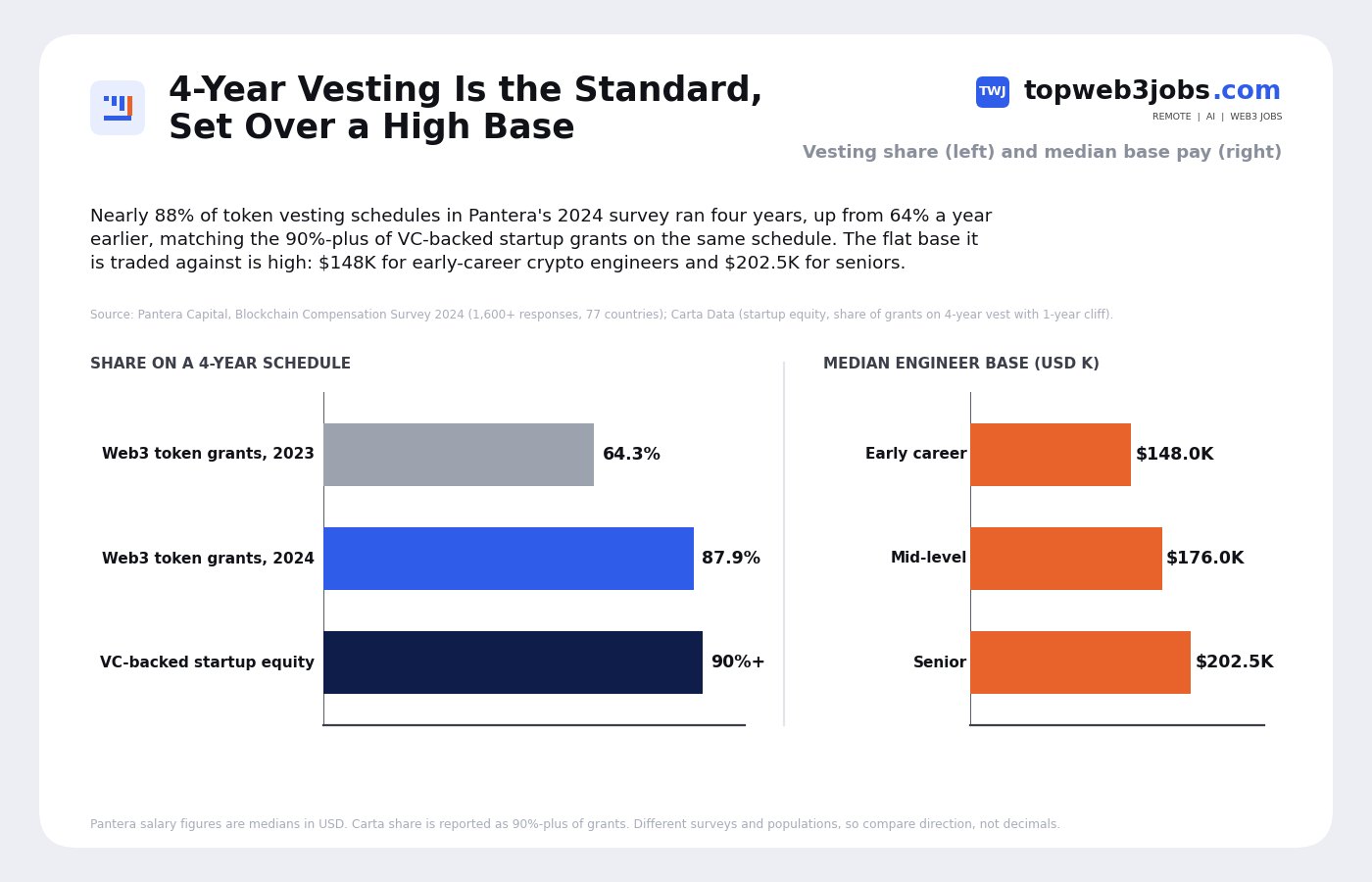
- Token vesting schedules on a four-year term rose from 64.3% in 2023 to 87.85% in 2024, according to Pantera
- Four-year vesting with a one-year cliff covers 90% or more of startup employee grants, according to Carta
- Median engineering base pay in crypto was $148,021 for early-career, $176,000 for mid-level and $202,500 for senior roles in 2024
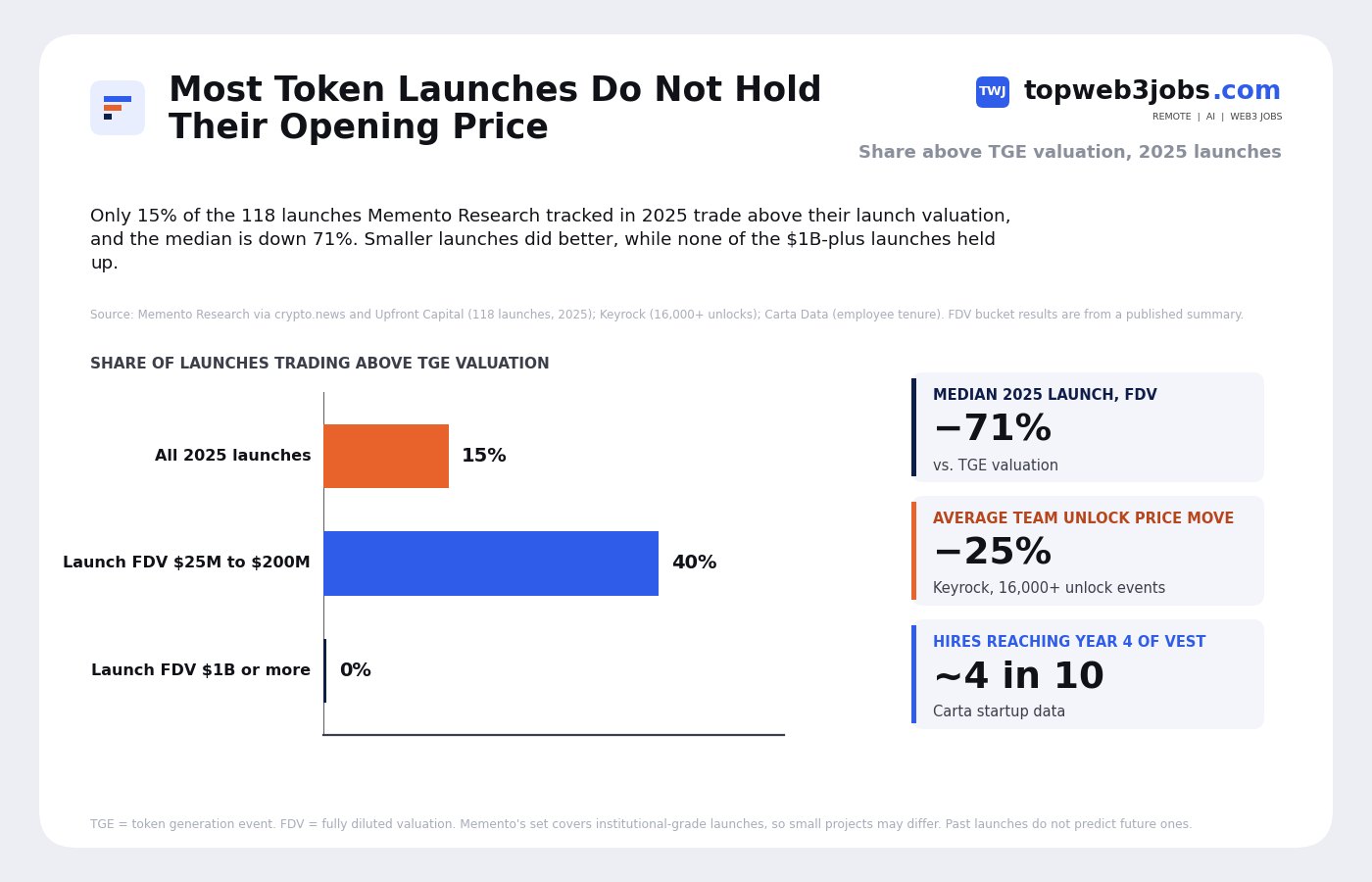
- Only 15% of the 118 token launches tracked by Memento Research in 2025 were above their launch valuation, and the median was down 71%
- Team token unlocks have averaged a 25% price drop, and about 90% of 16,000-plus unlock events created negative price pressure, per Keyrock
- About 4 in 10 startup employees reach the end of a four-year vest, according to Carta
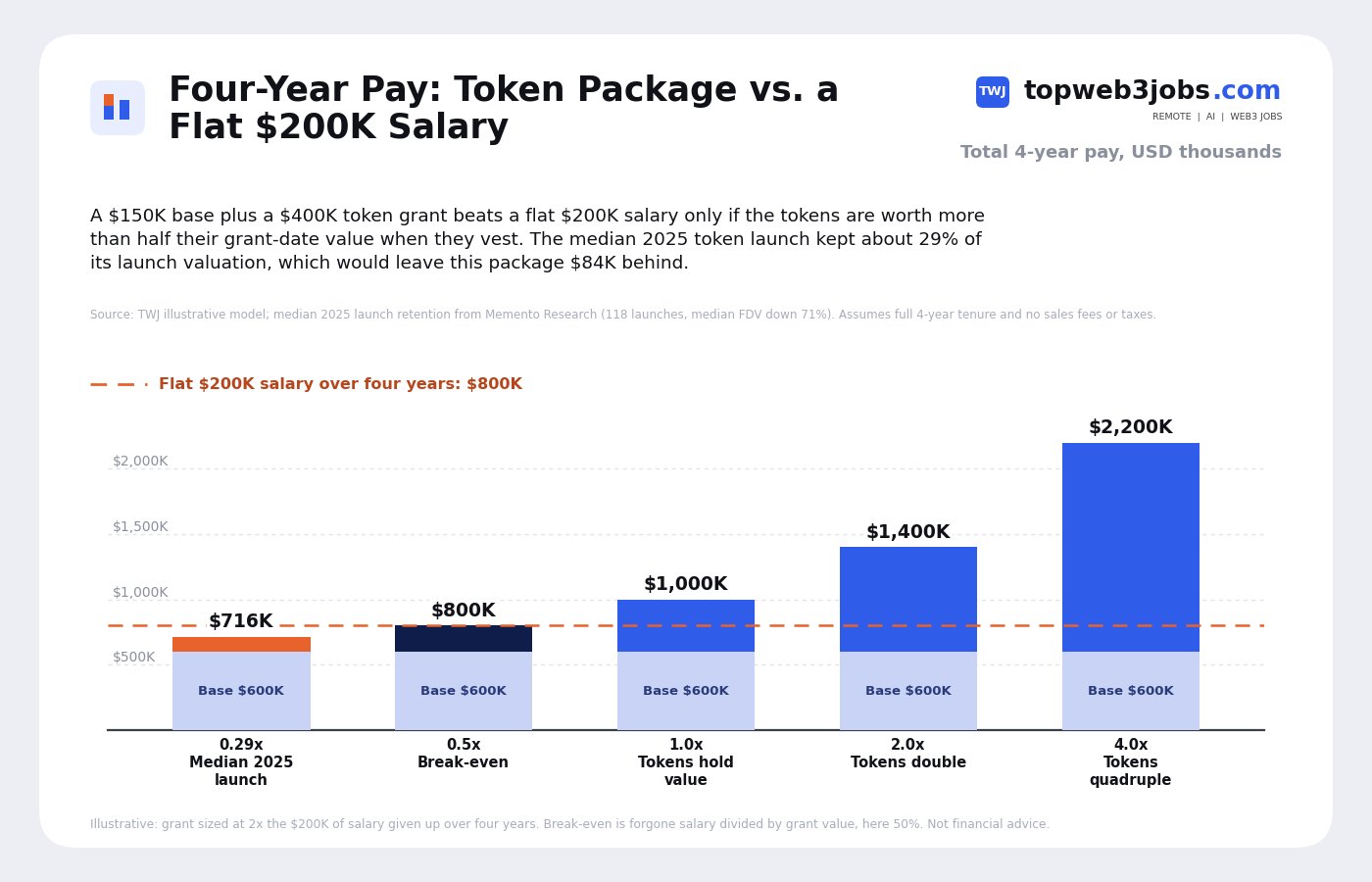
- A $150K base plus a $400K token grant beats a flat $200K salary only if tokens keep more than 50% of their grant-date value, in our model
How Standard Is the Four-Year Schedule?
Very standard, and getting more so. In the Pantera survey of more than 1,600 respondents in 77 countries, four-year token vesting rose from 64.3% of schedules in 2023 to 87.85% in 2024. Shorter one-, two- and three-year schedules shrank to between 1.7% and 6.6% each.
That mirrors the startup world. Carta reports that more than 90% of employees on its platform receive a four-year vest with a one-year cliff. A Framework Ventures survey found the same thing for Web3: vesting for both equity and tokens mostly follows the standard four-year schedule with a one-year cliff. Token schedules vary more by project, and some vested tokens stay locked for a further period, though they can often be used for staking or voting.
The other side of the offer is base pay. Pantera's 2024 data put median engineering base pay at $148,021 for early-career roles, $176,000 for mid-level and $202,500 for senior engineers. By company stage, seed-stage engineers had a median of $155,000, Series A $147,969 and Series B $198,000. Pantera notes that earlier-stage companies usually make up for lower pay with larger equity or token packages.
So the choice is rarely salary against nothing. It is a solid base against a smaller base plus a grant.
The Case For Vesting
There are real reasons builders accept the trade.
Unlimited upside. A flat salary has a ceiling. A grant does not. Even in a weak year, a few launches broke out. Aster, for example, was reported up more than 700% from its launch price in late 2025.
Fixed supply instead of dilution. Equity ownership gets diluted considerably over time, whereas token ownership is set against the maximum token supply, according to Framework. That only holds for tokens with a fixed supply, since inflationary tokens can still dilute holders.
Retention that pays. Carta data shows about 47% of startup employees receive a refresh grant around year two, and nearly 70% of those who complete their first four years receive more equity. A builder who stays often ends up with overlapping grants.
A growing share of pay is liquid anyway. Pantera found the share of professionals paid partly in crypto tripled from 3% in 2023 to 9.6% in 2024, mostly in stablecoins. That reduces the sense of a hard line between "token pay" and "salary."
The Case Against: What Tokens Have Actually Done
The upside only counts if the token holds up between the grant and the vest date, and 2025 launch data suggests that is the exception.
Memento Research tracked 118 token launches in 2025 and found 84.7% trading below their launch valuation. The median fully diluted valuation was down 71%, and median market cap down 67%. Only 18 launches were above their opening valuation. A summary of the same study reports that none of the launches at $1 billion or more in fully diluted value held up, while 40% of those between $25 million and $200 million did. That summary is secondary, so treat the bucket figures as indicative.
DWF Labs, drawing on the same Memento data, found typical drawdowns of 50% to 70% within 90 days of listing, with most tokens peaking within the first month. Airdrop selling and early investor unlocks were the main pressure points.
Unlocks are a second drag, and they hit the builders directly. Keyrock's study of more than 16,000 unlock events found about 90% created negative price pressure, with declines often starting around 30 days before the unlock date. Team unlocks were the most damaging, averaging up to a 25% drop, while ecosystem unlocks averaged a 1.18% gain. Unlocks below roughly 1% of circulating supply showed little measurable effect. Since builders' vests are often the same events, a four-year schedule that ends in a large unlock can lower the value of the tokens the builder is about to sell.
Running the Numbers: Token Package vs. Flat Salary
To test the headline claim, we compared two offers over four years.
- Offer A: a flat $200,000 salary, or $800,000 over four years
- Offer B: a $150,000 base plus a $400,000 token grant at grant-date value, vesting over four years with a one-year cliff
Offer B gives up $50,000 a year, or $200,000 over four years, in exchange for a grant sized at twice that amount. The break-even rule is simple. The grant needs to be worth the forgone salary divided by the grant value when it vests. Here that is $200,000 divided by $400,000, or 50% of its grant-date value.
At the median 2025 launch outcome, the tokens keep about 29% of value. Offer B pays $600,000 in base plus $116,000 in tokens, or $716,000 in total. That is $84,000, or about 10%, behind the flat salary. If tokens keep their value, Offer B pays $1,000,000. If they double, $1,400,000. If they quadruple, $2,200,000.
The shape of that result is the real finding. The downside is capped at the amount of salary given up, while the upside has no cap, and for tokens that are valued fairly the trade can be a good one. But if the median 2025 launch is the base case, the package loses.
Three further adjustments make the gap wider.
Tenure. The one-year cliff means nothing vests before month 12. A builder who leaves at month 11 collects $137,500 in base under Offer B against $183,333 under Offer A, a gap of about $45,800 before any tokens. Carta's data shows only about 4 in 10 startup employees make it to the end of their four-year grant, 52% of employees hired in 2019 had left within three years, and nearly 1 in 4 hired in 2022 left before a full year.
Package size. Pantera's survey, as reported by Crowdfund Insider, put the median token package at $87,500, against an average of $341,157. A median grant of $87,500 vesting over four years is worth about $21,900 a year at par. That is the most salary it can replace at par value. A builder taking a $50,000 base cut would need a much larger grant than the median.
Liquidity. The model assumes the builder can sell at the vest price. Some vested tokens stay locked, and selling into thin markets around an unlock can move the price, particularly for team members.
When Vesting Does Outperform
The same math points to the cases where a vesting package wins.
- The grant is large relative to the salary given up. The bigger the grant compared to the base cut, the lower the break-even. A grant at four times the forgone salary breaks even if tokens keep only 25% of their value.
- The project is smaller or earlier. The 40% success rate for $25 million to $200 million launches in Memento's buckets, against 0% at $1 billion or more, suggests builders joining lower-valuation projects face better odds than those joining hyped, high-FDV ones.
- The token has real utility and a fair float. Keyrock found larger unlocks relative to circulating supply cause bigger drops. Low-float, high-valuation designs make post-launch selling worse.
- The builder stays. Overlapping refresh grants mean the second and third years can pay more than the first.
How to Evaluate an Offer
The steps below are a TopWeb3Jobs editorial guide based on the data above.
Find the break-even. Divide the salary you give up over four years by the grant's grant-date value. That is the share of value the tokens must keep. If it is above 50%, ask whether the project has any basis for that.
Ask how the grant was valued. A grant priced at a recent funding round or an expected launch valuation can be far above where the token trades. Ask whether it uses fully diluted valuation, and what the circulating float will be at launch.
Check the cliff and post-vest locks. Ask whether vested tokens can be sold right away, whether there is a further lockup and what happens if the team leaves before the token exists.
Ask what happens if no token launches. Many protocols run equity and token rights side by side. A builder should know whether the token grant converts, is replaced or lapses.
Keep a base you can live on. A base well below the market median for your level, such as the $148,000 to $202,500 range Pantera reports, only makes sense if the grant is large and the project credible.
Ask about refreshes. Roughly half of startup employees see refresh equity around year two. Ask whether the project has a refresh policy, and whether it avoids the year-four drop in pay.
Look at the tax treatment where you live. How and when vested tokens are taxed varies by country, and it can interact with a falling price. Check this before signing.
Read the Numbers With Care
Pantera's survey is self-reported and skews toward experienced respondents, and token package figures vary widely between respondents. The $87,500 median and $341,157 average come from press coverage of the survey, not the survey page itself.
Memento's data covers 118 institutional-grade launches in 2025, not the whole market. The FDV-bucket success rates come from a published summary of the study. A different year or a recovering market could look quite different.
Keyrock's unlock results measure price changes around unlock events and do not isolate the cause. Prices often fall before the date as traders position ahead.
Carta's tenure figures describe startup equity employees in general, not protocol builders. Retention at crypto teams may differ.
Our model is illustrative. It assumes full tenure, a single sale at the vest price and no tax, and it sizes the grant at twice the forgone salary. Different assumptions change the break-even.
What to Watch Next
First, launch performance. If 2026 launches hold value better than 2025's, the median outcome moves toward the break-even and vesting packages become more attractive.
Second, pay structure. The jump in stablecoin pay suggests more teams may offer larger, stable-value bases alongside smaller grants.
Third, unlock design. Linear schedules and smaller unlocks relative to float tend to cause less disruption, and builders who negotiate those terms protect the value of their own vest.
The data supports one clear conclusion today: four-year vesting is the market standard, but it only outperforms a flat salary when the grant is large, the tenure is long and the token keeps at least its break-even share of value. On 2025 launch results, the typical protocol token did not.
Sources:
- Pantera Capital, Blockchain Compensation Survey 2024 (August 2025): vesting schedules, engineering base pay by level and stage, crypto salary share; Crowdfund Insider (2025): token package average and median
- Memento Research via crypto.news (December 2025) and Upfront Capital: 2025 token launch performance; DWF Labs via CoinMarketCap Academy (2026): post-launch drawdowns; Cryptopolitan (December 2025): Aster launch performance
- Keyrock, "From Locked to Liquidity: What 16,000+ Token Unlocks Teach Us," with summaries from Streamflow and BeInCrypto: unlock price effects
- Carta Data (2026): four-year vesting prevalence, employee tenure and refresh grants; Framework Ventures, "Navigating Web3 Compensation": vesting norms and token dilution